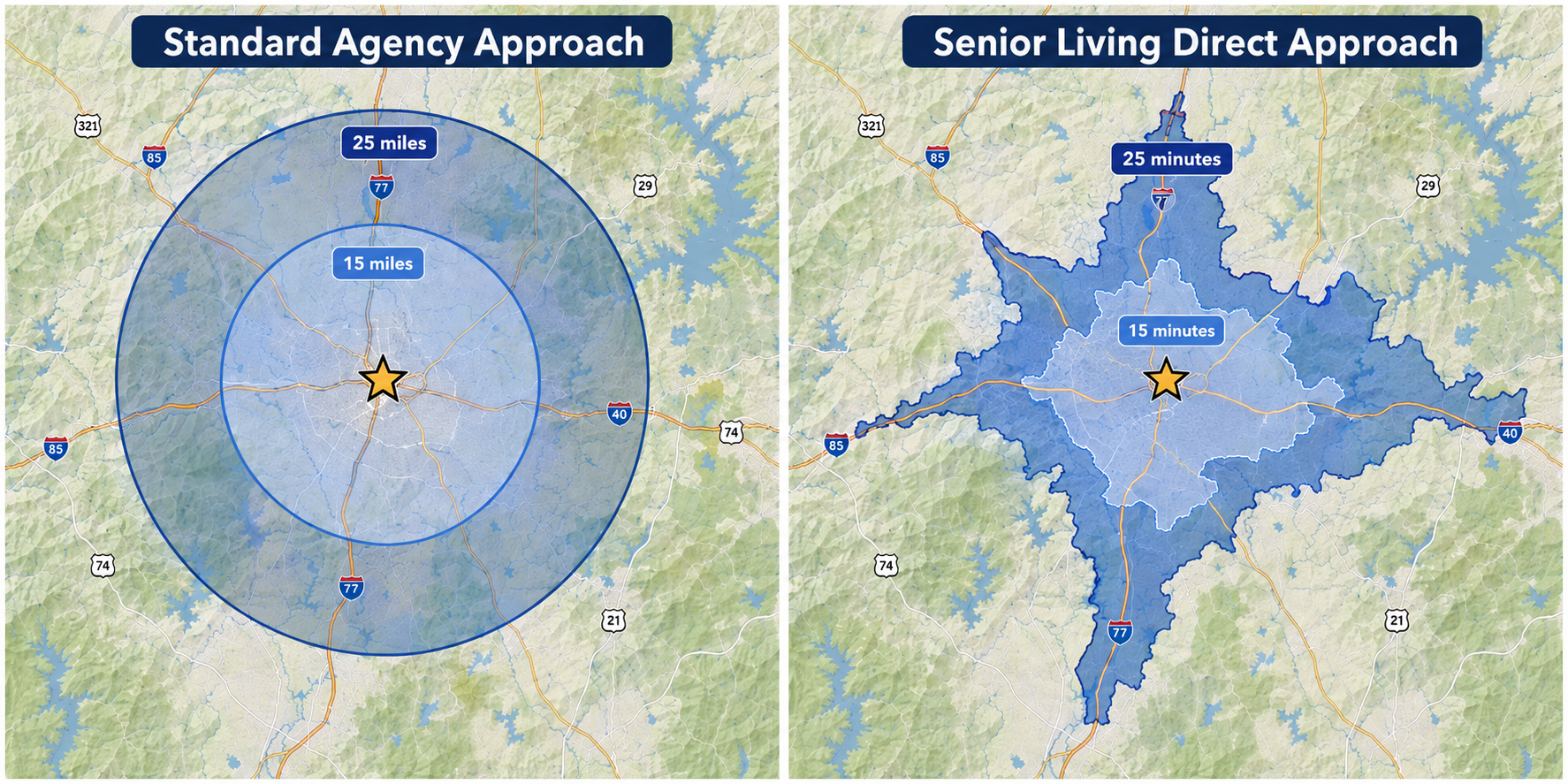
Drive time is the real boundary
Families don't decide in miles. They decide in minutes. "Can I get there after work?" "Can I be there in fifteen minutes if something happens at two in the morning?" That's the question behind every move-in, and it has almost nothing to do with the odometer.
Look at the two maps above. A mileage ring sweeps in thousands of households on the far side of a lake with no bridge, or across a county line where the only route is a two-lane road. Meanwhile it cuts off the neighborhoods sitting twenty-two miles out on an interstate, twenty easy minutes door to door, exactly the families most likely to tour.
Every piece mailed into the first group is wasted postage. Every household in the second group is a prospect your competitor mailed and you didn't.
The right drive time depends on the level of care
This is the part generalist agencies miss entirely. There is no single correct radius, because the person doing the driving changes with the care level, and so does how often they make the trip.
Independent living. The prospect is usually still driving themselves, and the move is a lifestyle decision made months in advance. They'll consider a wider band, but they anchor to their own life: their church, their doctor, their hairdresser, the grocery store they've used for thirty years. Adult children may visit monthly. The reach can be generous, but it should follow the roads they already drive.
Assisted living. Now the adult child is in the picture, and visits move from monthly to weekly or more. Weekly means the drive has to fit into a real week: after work, before the kids' practice, on a Saturday morning. The practical band tightens considerably, and it tightens along commuter routes, not evenly in all directions.
Memory care. Tightest of all. Families visit several times a week and sometimes daily, especially in the first months. They also need to be able to get there fast when the call comes. A daughter will rule out a community twenty-five minutes away and choose one twelve minutes away without ever articulating why. She's already imagining the drive at 6am.
Skilled nursing and rehab. Different geography again, because the decision often starts at a hospital discharge desk. The drive times that matter run from referring hospitals and physician groups as much as from households.
Mail the same circle for all four and you've overspent on three of them.
We've mapped this way for years
Drive-time mapping isn't new to us and it isn't an upcharge. We've built senior living lists this way for years, because it was obvious from the first campaigns we tracked that the circle was lying to us.
We map the true drive-time boundary around your community, calibrated to your care levels. We look at it at the hours families actually travel, not at 11am on a Sunday when everything looks close. We overlay it with the ZIP and carrier route geography the postal system actually uses, so the targeting survives contact with the mail stream. And we check it against where your current residents came from, which is the most honest market research any community owns and the most frequently ignored.
The result is a smaller list that costs less to mail and produces more tours. Fewer pieces, better households, same budget doing more work.
Geography is only the first filter
Once you've drawn the right boundary, you can be far more specific inside it than age and income allow.
If you're hosting a pet parade, mail the dog lovers. That's a real, purchasable selection: households with pets, pet product buyers, veterinary spend. If it's a garden party, there are gardeners. A veterans' luncheon, veterans. A jazz night, a bridge tournament, a grandparents' day, all of it can be selected against genuine consumer behavior rather than a guess about what a 78-year-old might like.
The same holds for the adult child, who is often the one who reads the invitation and makes the call. Households with a parent in the market, caregiving-related purchases, recent life-event indicators. These are all targetable, and they're a far better predictor than income alone.
Then target the same people twice
Mail still matters in this category. It sits on the kitchen counter, it gets shown to a daughter on Sunday, and it reaches a generation that checks the mailbox daily. But mail alone is a single impression against a decision that takes months.
So we run both. The same households that receive the pet parade invitation see the community in their feed and in their search results that week. Same addresses, same drive-time boundary, same interest selection, matched across mail and digital.
A prospect who gets the postcard and then sees you online has been reached twice by a campaign that cost slightly more than reaching them once. Response rates on matched programs run meaningfully higher than either channel by itself, and the improvement comes from precision, not volume.
What to ask your agency
One question: "Is our list built on miles or minutes?"
If the answer is miles, ask what a drive-time map of your market looks like and how many of the households you're currently mailing fall outside it. In most markets, the number is large enough to fund the rest of the campaign.